A New Egg-Quality Breakthrough: What It Means For IVF
For people over 40 who have already been through one or more rounds of IVF, the phrase “egg quality” can feel like a wall. Age does not simply affect whether pregnancy happens. It shapes the quality of eggs, embryo development, the risk of chromosome abnormalities, and ultimately the chance that an IVF cycle results in a healthy pregnancy.
That is why data presented at the Fertility 2026 conference in the UK this January attracted international attention. Researchers linked to Ovo Labs, a biotech company built on two decades of egg-biology research from the Max Planck Institute for Multidisciplinary Sciences, reported early laboratory results suggesting that a protein involved in chromosome stability could reduce one of the major age-related problems seen in human eggs.
The results are promising, but they are still preliminary. The experimental treatment is not available to IVF patients today, and it has not yet been shown to increase pregnancy or live-birth rates. So what does this research actually mean for people considering IVF after 40, and where do donor eggs still fit in?
What Is Ovo Labs, and Why Is Its Research Getting So Much Attention?
Ovo Labs is a fertility biotech company founded in January 2025 by three scientists connected to the Max Planck Institute for Multidisciplinary Sciences in Göttingen, with operations split between London and Munich rather than based in a single country.

Ovo Labs founding team, a fertility biotech company based in London and Munich
The company’s three co-founders are Professor Melina Schuh, who continues to lead the Department of Meiosis and serves as Managing Director at the Max Planck Institute in Göttingen; Dr. Agata Zielinska, a physician-scientist who now works full-time as Ovo Labs’ co-CEO; and Dr. Oleksandr Yagensky, a biologist and former Bain & Company strategy consultant who also serves as co-CEO. Schuh’s own role at the company, per Ovo Labs’ team page, is co-founder and scientific advisor, drawing on more than 20 years of research into why egg quality declines with age.
In April 2025, Ovo Labs raised roughly €4.7 million in seed funding, backed by investors including LocalGlobe, Creator Fund, and Antonio Pellicer, founder of the IVI RMA fertility clinic group. Product development takes place at the Life Science Factory in Munich. In January 2026, the company presented its first efficacy data at Fertility 2026, the UK’s largest fertility conference, for its lead candidate, EmbryoProtect 1.
Inside EmbryoProtect 1: How Shugoshin 1 Could Protect Chromosomes
EmbryoProtect 1 (EP1) is an experimental therapy that supplies eggs with extra Shugoshin 1 (SGO1), a protein named after the Japanese phrase for “guardian spirit,” and in Ovo Labs’ preclinical study it raised the share of chromosomally viable human eggs from about 47% to 71%.
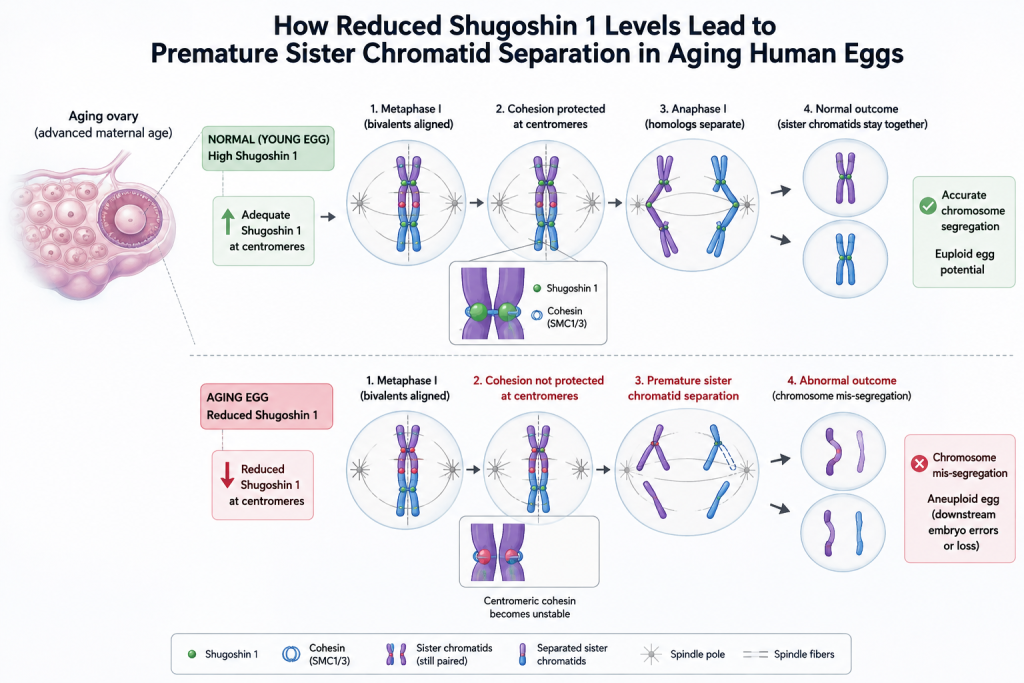
Diagram showing how reduced Shugoshin 1 levels lead to premature sister chromatid separation in aging human eggs.
According to the diagram, chromosomes in a maturing egg are held together by a structure called cohesin until the moment they are meant to separate. SGO1 and a related enzyme, PP2A, protect that structure at the centromere, the point where paired chromosomes are joined. As eggs age, activity at this region declines, cohesin weakens, and chromatids can separate too early, a problem called premature sister chromatid separation (PSSC). This is the leading biological driver of aneuploidy, the abnormal chromosome count behind most IVF failures, failed embryo transfers, and early miscarriages.
Mouse Models vs. Human Eggs: What Was Actually Tested
Much of the underlying mechanism was first demonstrated in mice, not people. The bioRxiv preprint reports that supplementing aged mouse oocytes with SGO1 restored centromeric protection and reduced PSSC to youthful levels. In aged human eggs donated by IVF patients, the researchers separately confirmed that SGO1 levels were reduced, and found that supplementing human eggs with SGO1 cut the proportion showing PSSC by roughly half. The two data sets support each other, but the human evidence is narrower than the mouse work behind it.
The Numbers Behind the Headlines
That 47%-to-71% figure, the one that generated most of the public excitement, comes from a preclinical study of just over 100 human eggs, donated by patients aged 22 to 43. It is worth sizing up the study itself: averaged across a 21-year age range, that works out to roughly five eggs per year of age, and Ovo Labs has not published how the effect varied by patient age or underlying fertility diagnosis.
What the Research Actually Proves, and What It Doesn’t
The findings have not yet demonstrated that EP1 can increase the chance of having a baby. The study is a preprint, meaning it has not been through peer review, and EP1 has not been tested in a clinical IVF cycle in which treated eggs were used to establish pregnancies and measure live births.
Independent experts have raised more specific questions than simple caution. In comments gathered by the Science Media Centre, Professor Robin Lovell-Badge of the Francis Crick Institute pointed out that earlier research had linked age-related chromosome loss more directly to a related protein, Shugoshin 2, which is generally understood to matter more during meiosis, while Shugoshin 1 is usually considered more important for mitosis. He said it was unclear from the materials released why Ovo Labs’ lead scientist focused on SGO1 rather than SGO2, and noted that no safety data, such as whether EP1-treated eggs developed normally to the blastocyst stage, had been published.
Professor Richard Anderson of the University of Edinburgh took a more optimistic view, calling the prospect of treating eggs to improve chromosome segregation a huge advance if the claims hold up, and noting the effect appeared even clearer in eggs from older women. Both experts agreed that confirmatory clinical trials, including safety studies, are still needed before any of this reaches patients.
In practical terms, EP1 is a promising experimental technology, not a treatment patients can ask their clinic for today. That distinction matters most for people over 40 who are making time-sensitive fertility decisions right now.
What Stands Between a Lab Result and a Clinic Appointment
Several distinct stages separate a laboratory result like this one from a treatment available at a fertility clinic, and each stage typically takes years rather than months.
Safety and Toxicology Studies Come First
Ovo Labs co-CEO Dr. Agata Zielinska has said the company’s next step is completing safety and toxicity studies in-house, at its own research facility, before any human clinical trial can begin. This stage is designed to catch problems a small preclinical study cannot, such as whether EP1 has effects beyond its intended target inside the egg.
Then Clinical Trials, and Only Then Approval
Only after safety data are in place can a therapy move into formal clinical trials, first testing whether treated eggs can be fertilized and develop normally, and eventually whether they lead to live births at a meaningfully higher rate than untreated eggs. Regulatory review follows trial results, not laboratory promise. Ovo Labs has said it aims to reach the clinical trial stage, but has not published a timeline for approval or public availability.
Why Egg Quality Becomes the Deciding Factor After 40
Chromosome abnormalities are estimated to affect more than 70% of a woman’s eggs by age 40, according to Ovo Labs’ own published materials, and they are the single biggest reason IVF success using a person’s own eggs falls with age, independent of any one company’s research. Per ASRM’s patient education materials, a woman’s age is considered the most accurate available marker of her egg quality, and the frequency of aneuploidy rises steadily as the number of remaining eggs declines.
During normal egg maturation, chromosomes must separate accurately, and the mechanisms that hold them together become less reliable with age. Aneuploid embryos frequently fail to implant or result in miscarriage.
The latest UK data illustrate the same pattern from a different angle. According to the HFEA’s Fertility treatment 2024 report, the average IVF birth rate per embryo transferred using a patient’s own eggs was 38% for patients aged 18-34 in 2024, compared with just 8% for patients aged 43-44. These are population averages for own-egg treatment, and they do not predict any individual’s personal chance of success.
Could an Egg-Quality Treatment Change IVF After 40?
EP1 could eventually change the odds for IVF after 40, but only if future clinical trials confirm the laboratory findings, resolve the open safety questions, and show a real increase in live births, not just in the proportion of chromosomally normal eggs.
Laboratory equipment used in IVF egg research ( Photo by Dmytro Vynohradov on Unsplash, free use under Upsplash license).
The idea behind EP1 differs from simply stimulating the ovaries to produce more eggs. Instead, researchers are trying to address one specific biological mechanism, cohesin loss at the centromere, that contributes to chromosome errors as eggs age. If future trials show this approach can safely produce more chromosomally competent embryos, and, more importantly, more pregnancies and live births, it could eventually become another tool in fertility treatment. That future is still several steps away, and patients should not delay an IVF decision while waiting for EP1 or similar treatments to become available.
Why PGT-A Doesn’t Solve the Same Problem
Some patients who have already been through IVF ask whether preimplantation genetic testing for aneuploidy (PGT-A) already covers this issue. It does not, at least not in the way EP1 aims to. PGT-A screens embryos that already exist and identifies which ones carry the correct number of chromosomes, so a clinic can prioritize transferring a chromosomally normal one. It does not reduce how many eggs or embryos are aneuploid in the first place, and it cannot help if none of the embryos produced in a cycle turn out to be normal. EP1, by contrast, is aimed at preventing the chromosome error from occurring in the egg at all. The two approaches are complementary in concept, not substitutes for each other.
Why Donor Eggs Still Matter
Donor eggs remain an established option for many patients over 40 because the chromosomal status of the resulting embryo depends far more on the age of the egg provider than on the age of the person carrying the pregnancy.
According to the HFEA’s Trends in egg, sperm and embryo donation report, the birth rate per embryo transferred for patients aged 18-34 using their own eggs was 33% in 2018-19, compared with just 5% for patients aged 43-50. When donor eggs were used instead, birth rates stayed above 30% across every age group.
What Really Determines Success: The Donor’s Age, Not Yours
The same HFEA report explains why: UK egg donors have a consistent average age of around 31, compared with an average age of 41 among the patients who use them, and donors are screened to be unlikely to have underlying fertility issues themselves. That gap, not the recipient’s own age, is what drives the higher and more stable success rates seen with donor eggs. More recent HFEA figures show how significant donor conception has become nationally: in the Fertility treatment 2024 report, one in five UK IVF births involved donor eggs, sperm, or embryos, accounting for roughly one in every 137 births in the country overall.
For someone considering IVF after 40, donor eggs are therefore worth discussing with a fertility specialist, particularly after unsuccessful cycles using one’s own eggs, or when ovarian reserve and egg quality are already known concerns.
Where This Approach Doesn’t Help
EP1, even in the best-case scenario where it eventually reaches the clinic, would not be a complete answer to age-related infertility. It targets a single mechanism, cohesin loss at the centromere, among several biological processes that contribute to declining fertility with age.
It does nothing, for instance, about diminished ovarian reserve, the natural decline in the number of eggs remaining in the ovaries, which is a separate problem from egg quality and cannot be reversed by improving the chromosomal accuracy of the eggs that remain. Embryo quality also depends on factors beyond chromosome count, including sperm contribution and the uterine environment. And because the published data so far come from a small preclinical study, it remains unknown whether the benefit seen in the laboratory would translate into meaningfully more live births once treated eggs are fertilized, cultured, and transferred under real clinical conditions.
Why Egg Donation Is Still Banned in Germany
Germany is home to some of the research behind this story, including work at the Max Planck Institute in Göttingen, yet egg donation itself remains prohibited on German soil under the country’s 1991 Embryo Protection Act (Embryonenschutzgesetz).
Under the official text of the law, transferring an egg cell from one woman to another for fertilization is a criminal offense in Germany, unlike sperm donation, which is legal. As a result, German patients who need donor eggs have long had to seek treatment abroad.
Current Legal Status vs. the Reform Debate
That may be starting to change, though nothing has changed yet. In April 2024, a government-appointed commission on reproductive self-determination concluded that Germany’s ban on egg donation is not constitutionally required, and recommended that lawmakers regulate it within a comprehensive reproductive medicine law rather than lifting the ban outright. As the Leopoldina, Germany’s National Academy of Sciences, has reported, Federal Health Minister Nina Warken has since opened a political discussion around partial legalization, focused on allowing eggs already retrieved during a patient’s own IVF cycle to be donated, while keeping commercial egg donation banned. As of this writing, the ban remains fully in effect, and no legislation has passed.
For German patients, and for patients across much of Europe, Australia, and Singapore, where egg donation is either restricted or where matched-donor waiting lists run long, this means international donor-egg programs remain a practical, current option rather than a future one.
What EP1 Means If You Are Over 40 and Trying to Conceive Now
For someone trying to conceive now, EP1 offers something genuinely valuable at this stage: a credible research direction, not yet an available treatment.

Couple over 40 exploring their fertility treatment options ( Photo by Kelly Sikkema on Unsplash, free use under Upsplash license).
Researchers are, for the first time, exploring whether a specific mechanism behind age-related egg deterioration can be directly targeted and reversed, at least in a laboratory setting. But hope should not be confused with an available option. Today, EP1 is still experimental, unproven in a clinical trial, and not approved for use anywhere. For people who want to become parents now, the relevant conversation is still about the established options available through fertility clinics: IVF using one’s own eggs, and, where appropriate, IVF with donor eggs.
What a Verified Egg Donor Profile Actually Includes
For patients weighing donor eggs for the first time, it helps to know what a properly screened donor profile actually contains. Reputable agencies typically require each donor to complete a full medical and personal history, including family medical background, education, and lifestyle information, alongside infectious disease screening covering hepatitis B and C and HIV, blood testing, and an ultrasound assessment of ovarian reserve before she is approved. Non-anonymous programs also include real photos and a personal statement from the donor, so intended parents are choosing based on complete information rather than a handful of data points.
This level of screening exists precisely because donor egg quality, not the recipient’s age, is what drives outcomes, as the HFEA data above illustrates. A thorough profile is not paperwork for its own sake; it is the mechanism that makes the higher, more consistent success rates associated with donor eggs possible in practice.
Considering Donor Eggs? Talk to Sunshine Egg Donation Agency
If you are over 40 and exploring your fertility options, you do not have to base your decision on headlines about experimental treatments alone. Sunshine Egg Donation Agency works with intended parents across Europe, Australia, Singapore, Canada, and India, helping them explore donor egg programs and the process of selecting a donor from a screened, non-anonymous database. Whether you are considering donor eggs for the first time or looking at alternatives after unsuccessful IVF cycles, a consultation can walk you through the donor selection process and the factors worth weighing when choosing a match.
Visit Sunshine Egg Donation Agency to request a personal consultation about egg donor selection, and find out what options may be realistic for your family right now.
FAQ: Egg Quality, IVF After 40, and Donor Eggs
What is EmbryoProtect 1 (EP1)?
EmbryoProtect 1 is an experimental fertility therapy developed by Ovo Labs, described in a bioRxiv preprint posted in January 2026. It supplies eggs with the protein Shugoshin 1 (SGO1), which helps hold chromosomes together correctly as an egg matures. In laboratory experiments on donated human eggs, the treatment reduced a chromosome-separation error called PSSC by roughly half, according to the preprint’s authors.
Is EmbryoProtect 1 available for IVF patients now?
No. As reviewers quoted by the Science Media Centre have noted, the research is an unpublished preprint that has not gone through peer review, and EP1 has not been tested in a clinical IVF trial. Ovo Labs has said the next step is completing in-house safety and toxicity studies before any clinical trial can begin, a process that typically takes years.
Does EP1 mean that egg donors will no longer be needed?
Not in the foreseeable future. Even if EP1 eventually becomes an approved treatment, it would likely reduce, not eliminate, age-related chromosome errors. Per HFEA data, donor eggs already produce birth rates above 30% across all recipient ages, because outcomes depend mainly on the donor’s age. For patients over 40 today, donor eggs remain the more established, better-documented option.
Why does IVF success decline after 40?
Age-related decline in egg quality increases the likelihood of chromosome abnormalities, or aneuploidy, in a woman’s eggs. According to the HFEA’s 2024 report, the average IVF birth rate per embryo transferred using a patient’s own eggs was 38% for ages 18-34, compared with just 8% for ages 43-44, reflecting this decline directly.
Can donor eggs improve IVF success after 40?
Yes, substantially. Per the HFEA’s Trends in egg, sperm and embryo donation report, birth rates for patients aged 43-50 rise from around 5% using their own eggs to over 30% using donor eggs, because the chromosomal status of the resulting embryo depends mainly on the donor’s age rather than the recipient’s.
Does Germany allow egg donation?
No, not currently. Under Germany’s Embryo Protection Act (Embryonenschutzgesetz), transferring a donated, unfertilized egg to another woman remains a criminal offense, even though IVF and sperm donation are legal there. A 2024 government commission found the ban is not constitutionally required, and political discussion of partial reform is ongoing, but no law has changed yet.
What should I do if I’ve had unsuccessful IVF cycles after 40?
Speak with a qualified fertility specialist about your medical history, ovarian reserve, and previous IVF outcomes. Depending on your circumstances, your doctor may discuss adjusting your IVF protocol, PGT-A embryo testing where appropriate, or alternatives such as donor egg IVF, which tends to offer more stable success rates after 40.
Where can I get help choosing an egg donor?
If you are considering donor egg IVF, Sunshine Egg Donation Agency offers a personal consultation covering the donor selection process, available programs across Europe, Australia, Singapore, Canada, and India, and the medical and personal factors worth weighing when choosing a donor match.