IVF with Donor Eggs After 40: What Research Says About Mother and Donor Health

For many men and women over 40, IVF with donor eggs offers a realistic path to parenthood when ovarian reserve, egg quality, or previous treatment outcomes make using their own eggs difficult. It is natural to ask whether the process is safe — for the egg donor, the intended mother, and the future baby.
That is why every year of new research into donor-egg pregnancy deserves attention. But it also deserves context.
The most accurate answer in 2026 is reassuring but not simplistic. Long-term cancer studies relate primarily to the donor’s health, because she is the one who receives stimulation. For the intended mother, the most important additional concern is a higher risk of hypertensive pregnancy complications, particularly preeclampsia. This risk is real, especially after 40, but it can be monitored and managed through personalised obstetric care.
In IVF with donor eggs after 40, only the donor undergoes ovarian stimulation, so long-term cancer studies concern her health; the intended mother’s main added risk is high blood pressure in pregnancy, which affected about 3 in 100 donor-egg pregnancies in women aged 40 to 45 in a 2024 study, against 1 in 100 after natural conception.
Who Actually Faces the Risks of Ovarian Stimulation?
In a donor-egg programme only the donor takes ovarian-stimulation drugs; the intended mother receives oestrogen and progesterone to prepare her uterine lining, so research on stimulation risks describes the donor’s exposure, not hers.
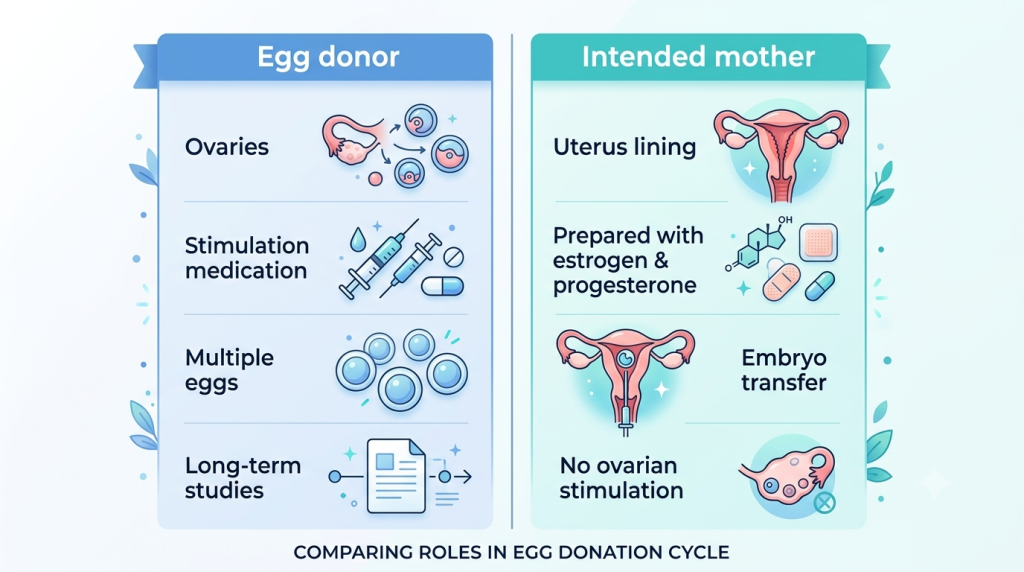
Ovarian stimulation: donor vs. intended mother
The donor receives medication to stimulate the ovaries and produce multiple mature eggs. The intended mother does not undergo ovarian stimulation. Instead, her uterine lining is prepared with hormones before embryo transfer.
This distinction matters when interpreting research. Studies investigating the possible long-term effects of ovarian stimulation — including breast or ovarian cancer — examine the health of women who received stimulation. They do not show that the intended mother is exposed to the same ovarian risks, because her ovaries are not being stimulated to produce eggs.
The recipient still requires careful medical assessment, especially after the age of 40. However, her main pregnancy-related risks are linked to factors such as age, blood pressure, general health, embryo transfer type, and the immunological and placental aspects of donor conception — not to ovarian stimulation.
Does Ovarian Stimulation Increase Cancer Risk for the Donor?
Ovarian stimulation for IVF did not raise long-term breast cancer risk in the Dutch OMEGA cohort: among 25,108 women followed for a median of 21.1 years, the standardised incidence ratio was 1.01, per a 2016 study in JAMA.
The study found no significant increase in breast cancer among women who underwent IVF compared with the general population or with women who received non-IVF fertility treatment. A ratio of 1.01 means the number of cases was essentially what would be expected without IVF.
These findings do not mean that every medical question has been permanently settled. Research continues, and individual cancer risk depends on family history, age, genetics, lifestyle, and other factors. Nevertheless, the available long-term evidence does not support the idea that standard ovarian stimulation for IVF substantially increases breast cancer risk.
What About Ovarian Cancer?
The same OMEGA research project found no increased ovarian cancer risk after IVF when women were compared with a non-IVF fertility-treatment group, in a follow-up of more than 40,000 women published in the Journal of the National Cancer Institute in 2020. The result remained reassuring after three or more IVF cycles and after 20 years of follow-up, according to the Netherlands Cancer Institute’s summary of the study.
For intended parents, the practical point is important: these studies concern the donor or patient who underwent ovarian stimulation. The intended mother in a donor-egg programme does not receive that stimulation.
“Patients often assume the cancer research applies to them because they’re the ones having the baby,” says Dr. Elena Popova, reproductive specialist at Sunshine Egg Donation Agency. “We explain early on that the stimulation studies are about the donor’s ovaries, not the recipient’s — the recipient’s own risk picture is a different conversation.”
What Risk Is Actually Higher for the Intended Mother?
Preeclampsia is the risk most consistently raised by donor-egg pregnancy: singleton oocyte-donation pregnancies had about 4.4 times the odds of hypertensive disorders compared with spontaneous conception in a 2021 meta-analysis of 85 studies in BMC Pregnancy and Childbirth.
Preeclampsia is a pregnancy complication involving high blood pressure and signs that organs — often the kidneys or liver — are under stress. If untreated, it can become serious for both mother and baby.
In the 2021 review, oocyte donation carried the highest odds of hypertensive disorders of any group analysed. Earlier evidence points the same way. A 2018 meta-analysis of six retrospective cohort studies in JBRA Assisted Reproduction (Schwarze et al.) compared donor-egg IVF with IVF using a woman’s own eggs in women aged 35 to 49. It reported a risk ratio of 2.62 for preeclampsia with donor eggs (the abstract gives an odds ratio of 4.50).
These are relative risk measures, not a prediction that every recipient will develop preeclampsia. A higher odds ratio does not mean that preeclampsia is inevitable. It means the pregnancy deserves structured risk assessment and closer monitoring.
Does Fresh or Frozen Transfer Matter?
Embryo transfer type changes hypertensive risk only modestly: in a 2019 study of about 1.47 million pregnancies in the American Journal of Obstetrics and Gynecology (Luke et al.), the adjusted odds of hypertensive disorders were 1.92 after fresh donor-egg transfer and 1.70 after frozen donor-egg transfer, both compared with fresh IVF using the woman’s own eggs.
Fresh IVF with her own eggs was itself almost identical to natural conception in the same study, with an adjusted odds ratio of 1.04. Frozen transfer with her own eggs sat between the two, at 1.30.
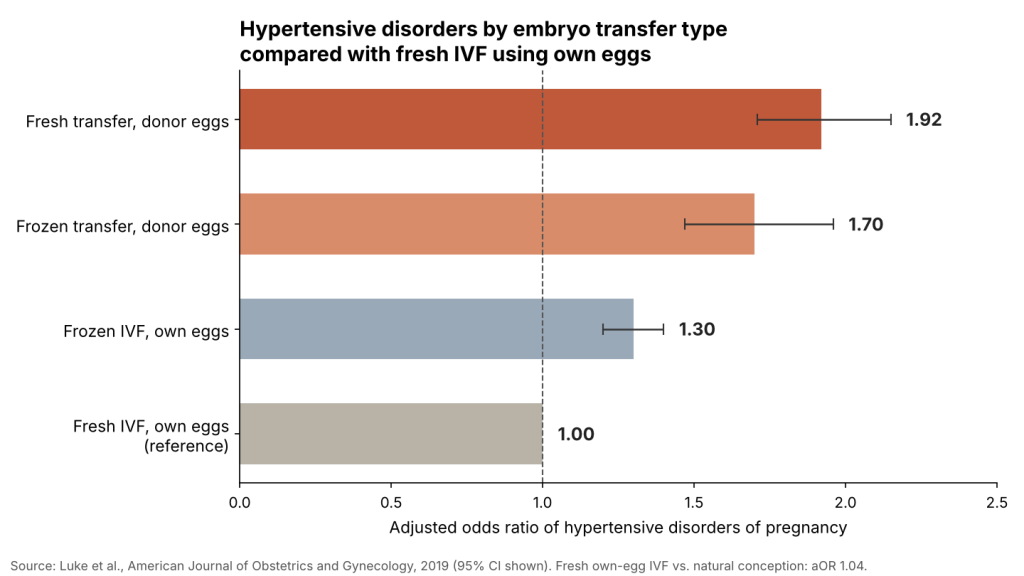
Hypertensive disorders by embryo transfer type, compared with fresh IVF using own eggs (Luke et al., 2019)
Across all IVF, frozen transfers tend to show slightly higher odds than fresh ones (1.74 vs. 1.43 against spontaneous conception in the 2021 BMC meta-analysis), while within donor-egg cycles Luke et al. found the reverse. The gap is small either way. These figures help doctors plan care, but they should not be used to choose fresh or frozen transfer without considering the individual treatment plan, embryo quality, endometrial preparation, and clinic protocol.
What Do Newer Studies Say About IVF With Donor Eggs After 40?
Women aged 40 to 45 who conceived with donor eggs had hypertensive disease in pregnancy significantly more often than women who conceived spontaneously, in a 2024 cohort of 28,916 pregnancies in the Journal of Assisted Reproduction and Genetics (Rahav-Koren et al.).
Age-specific data matters because many donor-egg studies mix younger and older recipients, while the decision to use donor eggs is often made after 40. The 2024 study compared spontaneous conception, IVF with a woman’s own eggs, and oocyte donation, using national health data from 2000 to 2019. Hypertensive disease was more common after both oocyte donation and IVF with autologous eggs than after spontaneous conception, and it was itself one of the statistically significant predictors of preterm labour before 37 weeks in this age group.
A larger, ongoing effort may sharpen the picture further. The PRIOR study (Pre-eclampsia Risk In Oocyte Recipients), led by Copenhagen University Hospital, Hvidovre, and actively recruiting as of 2026, aims to enrol 462 women. It follows women pregnant after oocyte donation alongside women pregnant after IVF with their own eggs, tracking blood pressure, blood markers, and pregnancy outcomes to characterise preeclampsia risk in donor-egg recipients.
Taken together, the newer research does not change the core message: preeclampsia risk is higher after donor-egg conception, and it remains elevated in women aged 40 to 45. What it adds is more precise, age-matched evidence for exactly the group considering donor-egg IVF later in life — and a reason to expect clearer risk-stratification tools within the next few years.
What Do These Odds Ratios Mean in Absolute Terms?
An odds ratio of about 4 does not mean a 4-in-10 chance: in the 2024 cohort of women aged 40 to 45, hypertensive disease occurred in 3.3% of donor-egg pregnancies against 1% after spontaneous conception, per Rahav-Koren et al. in the Journal of Assisted Reproduction and Genetics.
Odds ratios compare groups; they do not say how often something happens. Tripling a 1% risk ends at about 3%, while tripling a 10% risk ends at 30%. The starting point matters as much as the multiplier, and it differs between populations, clinics, and how carefully blood pressure is recorded.
The 2024 figures carry one more caveat. The donor-egg group included only 300 pregnancies, against 26,379 spontaneous ones, so the estimate is less precise than the total sample size suggests. The true rate may be higher or lower in other populations.
What the study shows clearly is direction. Hypertensive disease was more common after donor-egg conception, and in this age group it was a statistically significant predictor of preterm birth before 37 weeks (odds ratio 3.4), alongside maternal age.
For intended parents, the practical reading is threefold. The risk is several times higher than in a natural pregnancy. In this cohort, the large majority of donor-egg pregnancies still had no hypertensive disease. And the added risk is the reason to plan monitoring from the start, not a reason to avoid treatment.
Why Might Donor-Egg Pregnancy Raise Preeclampsia Risk?
Two explanations are discussed most often: the mother’s immune response to an embryo that is genetically unrelated to her, and a cycle without a corpus luteum, which a 2019 study in Hypertension linked to preeclampsia in 12.8% of pregnancies against 3.9% when one was present.
In natural conception and in IVF with a woman’s own eggs, half of the embryo’s genes come from the mother. With donor eggs, none do. A 2011 review in Transplant Immunology (van der Hoorn et al.) proposed that the maternal immune system may then protect early placental development less effectively, which could lead to preeclampsia. The authors present this as a hypothesis, not a proven mechanism.
The second explanation concerns the corpus luteum, the structure that forms in the ovary after ovulation and produces hormones that help blood vessels adapt to pregnancy. Recipients of donor eggs often have their uterine lining prepared with oestrogen and progesterone in a programmed cycle, in which no ovulation takes place and no corpus luteum forms.
In a 2019 study of 683 singleton births from women’s own eggs, published in Hypertension (von Versen-Höynck et al.), preeclampsia occurred in 12.8% of pregnancies after frozen transfer in programmed cycles without a corpus luteum, against 3.9% after modified natural cycles with one (adjusted odds ratio 2.73).
That study did not include donor-egg pregnancies, so its findings apply to recipients by extension. For many recipients over 40 a natural cycle is not an option, because ovulation is irregular or absent. Whether a different preparation protocol is possible is a question for the fertility team, not a reason to change plans on one study.
How Can Preeclampsia Risk Be Reduced?
Low-dose aspirin, usually 81 mg a day started after 12 weeks of pregnancy, is the main preventive measure the US Preventive Services Task Force and ACOG recommend for women with preeclampsia risk factors, which include IVF conception and age 35 or older.
Blood pressure monitoring in donor-egg pregnancy after 40, photo by Mikhail Nilov, free use by Pexels
Risk cannot always be eliminated, but it can be addressed early. Before treatment, the fertility and obstetric teams should review:
- Blood pressure and cardiovascular health
- Kidney disease, diabetes, autoimmune conditions, and previous preeclampsia
- Body mass index and family history
- Maternal age and whether this is a first pregnancy
- The planned embryo-transfer protocol
- Whether a singleton pregnancy is recommended and medically appropriate
The US Preventive Services Task Force lists in vitro conception and age 35 or older among moderate risk factors for preeclampsia, and notes that people with two or more moderate risk factors may benefit from low-dose aspirin. A woman over 40 who conceives with donor eggs already has both. ACOG Committee Opinion 743 advises starting low-dose aspirin, typically 81 mg daily, between 12 and 28 weeks, ideally before 16 weeks, and continuing it according to the obstetrician’s advice. Age-related pregnancy risks are covered in ACOG’s guidance on pregnancy at 35 or older.
Aspirin should never be started without medical advice. The correct timing and dose depend on the patient’s health, pregnancy history, medications, allergies, and bleeding risk.
“We ask about blood pressure history at the very first consultation, not after a positive pregnancy test,” says Dr. Elena Popova. “A preeclampsia-prevention plan works best when it starts before the transfer, not after a symptom appears.”
Does Egg Donation Cause Earlier Menopause in the Donor?
IVF stimulation did not bring menopause forward in about 700 women treated at Bourn Hall Clinic between 1981 and 1994; their age at menopause tracked their mothers’ age at menopause instead, per a 2008 Progress Educational Trust report on the follow-up.
This question is often asked for ethical reasons. Intended parents may want reassurance that ovarian stimulation will not compromise the donor’s future health.
The Bourn Hall follow-up also found no increase in perimenopausal symptoms. A smaller 2021 study of 100 women in the International Journal of Women’s Health found menopause about 0.8 years earlier after IVF (49.8 vs. 50.7 years), a difference its authors described as not clinically significant.
As with all medical research, this should not be interpreted as a guarantee for every individual. Both studies followed IVF patients rather than egg donors. Donors require proper screening, informed consent, appropriate medication protocols, and follow-up care. A responsible agency and fertility clinic should treat donor safety as a central priority.
What the Evidence on Donor-Egg IVF Cannot Tell You Yet
The research behind this article is observational and was mostly collected in women treated for infertility, so it describes associations in those groups rather than proving cause and effect for every egg donor or recipient.
- Donors were not the study group. OMEGA and the Bourn Hall follow-up studied women treated for infertility. Egg donors are typically younger, have no infertility diagnosis, and complete fewer cycles, so the findings are applied to them by extension rather than measured directly.
- One ovarian finding is less reassuring. In the 2020 OMEGA analysis, borderline ovarian tumours, which are not cancer but can need surgery, were about twice as common after IVF as in both comparison groups. The risk did not rise with more cycles, which makes a direct hormonal effect uncertain, per the Netherlands Cancer Institute.
- The over-40 donor-egg group is small. The 2024 age-specific cohort included 300 donor-egg pregnancies, so its rates are estimates with wide uncertainty.
- Mechanisms are still hypotheses. The immune and corpus luteum explanations are plausible, but neither has been confirmed in donor-egg recipients specifically.
These limits do not change the overall message. They explain why individual assessment matters more than any single statistic.
What Does “Safe” Mean After 40?
For intended parents over 40, “safe” means that preeclampsia, the main added risk of donor-egg pregnancy, is identified before transfer and managed during pregnancy, not that the risk is zero.
The evidence supports several practical conclusions:
- The long-term cancer studies on ovarian stimulation primarily concern the donor, not the recipient
- Long-term research has not shown a significant increase in breast cancer after IVF stimulation
- Ovarian cancer risk was not increased compared with non-IVF fertility treatment, including after repeated treatment and long follow-up
- Donor-egg pregnancy is associated with a meaningfully higher risk of preeclampsia, and that risk remains elevated in women aged 40–45
- Age 40+ requires attentive antenatal care regardless of whether the eggs are from the intended mother or a donor
- Early blood-pressure assessment, appropriate screening, single-embryo transfer when clinically suitable, and preventive treatment when indicated can improve safety
The goal is not to create unnecessary fear. It is to replace vague worries with a clear care plan.
IVF With Donor Eggs After 40: Key Numbers in 2026
The six figures below summarise what current research says about donor-egg IVF after 40, each with the study it comes from.
| Question | Finding | Source |
|---|---|---|
| Breast cancer after IVF stimulation | No increase: SIR 1.01, 25,108 women, median 21.1 years | OMEGA, JAMA 2016 |
| Ovarian cancer after IVF | No increase vs. other fertility treatment, 40,000+ women | OMEGA, JNCI 2020 |
| Hypertensive disorders, donor eggs | OR 4.42 vs. spontaneous conception (singleton) | BMC Pregnancy and Childbirth 2021 |
| Hypertensive disease, age 40–45 | 3.3% with donor eggs vs. 1% spontaneous | J Assist Reprod Genet 2024 |
| Fresh vs. frozen donor-egg transfer | aOR 1.92 / 1.70 vs. fresh own-egg IVF | Luke et al., AJOG 2019 |
| Earlier menopause after IVF | Not found in ~700 women; mother’s menopause age predicted timing | Bourn Hall follow-up, 2008 |
FAQ: IVF With Donor Eggs After 40
Short answers to the questions intended parents over 40 ask most often about the safety of IVF with donor eggs.
Does IVF with donor eggs increase cancer risk for the intended mother?
No evidence shows that the intended mother faces an increased cancer risk from ovarian stimulation in a donor-egg programme, because she does not undergo ovarian stimulation; only the donor does. Among women who were stimulated, the 21-year OMEGA follow-up of 25,108 women, published in JAMA in 2016, found no significant increase in breast cancer after IVF.
Which risk is genuinely higher with donor eggs?
The main added risk is preeclampsia. A 2021 meta-analysis of 85 studies in BMC Pregnancy and Childbirth found that singleton donor-egg pregnancies had about 4.4 times the odds of hypertensive disorders of pregnancy compared with spontaneous conception, the highest of any group analysed. A 2018 meta-analysis also found higher preeclampsia risk than with IVF using a woman’s own eggs.
Is the risk different for women over 40 specifically?
It remains elevated. In a 2024 cohort of women aged 40 to 45 published in the Journal of Assisted Reproduction and Genetics, hypertensive disease occurred in 3.3% of donor-egg pregnancies against 1% after spontaneous conception. The donor-egg group was small, at 300 pregnancies, and the Danish PRIOR study is now investigating the question further.
Can preeclampsia risk be reduced?
Often, yes. Early risk assessment, regular blood-pressure monitoring, and preventive treatment when appropriate all help. The US Preventive Services Task Force lists IVF conception and age 35 or older as moderate risk factors, and ACOG advises low-dose aspirin, commonly 81 mg daily started between 12 and 28 weeks and ideally before 16 weeks, only under medical supervision.
Does egg donation cause earlier menopause in the donor?
Current evidence does not suggest it. A follow-up of about 700 women treated with IVF at Bourn Hall Clinic between 1981 and 1994 found that their age at menopause tracked their mothers’ age at menopause rather than their IVF treatment. These women were IVF patients rather than donors, so the finding applies to donors by extension.
Is the risk different for fresh and frozen donor embryos?
Slightly. In a 2019 study of about 1.47 million pregnancies in the American Journal of Obstetrics and Gynecology, the adjusted odds of hypertensive disorders were 1.92 after fresh donor-egg transfer and 1.70 after frozen donor-egg transfer, both compared with fresh IVF using the woman’s own eggs. The choice of transfer type should be individualised by the fertility team.
Does higher preeclampsia risk mean donor-egg pregnancy is unsafe?
No. A higher relative risk means the pregnancy needs closer supervision, not that complications are likely. In a 2024 cohort of women aged 40 to 45, about 97% of donor-egg pregnancies had no hypertensive disease. Many donor-egg pregnancies progress successfully when patients receive timely obstetric care and early blood-pressure assessment, and follow medical recommendations.
How do I find a donor-egg programme that plans for preeclampsia risk after 40?
Ask before you start. A programme that plans for preeclampsia should review your blood pressure and medical history at the first consultation, explain its single-embryo transfer policy, discuss how your uterine lining will be prepared, and coordinate with an obstetrician who can start low-dose aspirin when indicated. Sunshine Egg Donation Agency raises these questions with intended parents before treatment begins.
Donor-Egg IVF After 40: Reassuring on Cancer, Cautious on Preeclampsia
The research on donor-egg IVF after 40 is genuinely reassuring on one front and genuinely cautionary on another. The cancer questions that worry many intended parents turn out to concern the donor, not the recipient, and decades of follow-up data support that distinction. The preeclampsia question is different: it is real, it is better documented every year, and it remains elevated in women over 40.
Neither of those facts is a reason to avoid donor-egg IVF after 40. They are reasons to plan for it with the right specialists, the right screening, and the right monitoring from the very first consultation.
If you are considering IVF with donor eggs and want to understand your individual risk profile before beginning treatment, Sunshine Egg Donation Agency offers consultation and support for intended parents. The team can help you select a donor and coordinate with your fertility specialist and obstetrician on a monitoring plan tailored to your age, health history, and pregnancy goals. Reach out to Sunshine Egg Donation Agency to arrange a consultation about your donor-egg programme before you begin treatment, not after.
Sources and Further Reading
- Ovarian stimulation for IVF and long-term risk of breast cancer — OMEGA cohort, JAMA 2016
- Long-term risk of ovarian cancer and borderline tumors after assisted reproductive technology — OMEGA, JNCI 2020
- No increased long-term risk of ovarian cancer after IVF — Netherlands Cancer Institute
- Assisted reproductive technology and hypertensive disorders of pregnancy — systematic review and meta-analyses, BMC Pregnancy and Childbirth 2021
- Is the risk of preeclampsia higher in donor oocyte pregnancies? — Schwarze et al., JBRA Assisted Reproduction 2018
- In vitro fertilization and risk for hypertensive disorders of pregnancy: associations with treatment parameters — Luke et al., AJOG 2019
- Obstetric and maternal outcomes of IVF and oocyte donation pregnancies among women ages 40–45 — J Assist Reprod Genet 2024
- PRIOR Study (Pre-eclampsia Risk In Oocyte Recipients) — ClinicalTrials.gov NCT07263490
- Egg donation pregnancy as an immunological model for solid organ transplantation — van der Hoorn et al., Transplant Immunology 2011
- Increased preeclampsia risk with IVF cycles in the absence of a corpus luteum — von Versen-Höynck et al., Hypertension 2019
- Low-dose aspirin for the prevention of preeclampsia — US Preventive Services Task Force, 2021
- ACOG: Pregnancy at Age 35 Years or Older
- IVF does not lead to early menopause — Progress Educational Trust
- Impact of IVF on the timing and symptoms of menopause — International Journal of Women’s Health 2021
Medically reviewed by Dr. Elena Popova, reproductive specialist
Published: October 2026 | Last updated: October 2026
Medical disclaimer: This article is for educational purposes only and does not replace personalised medical advice. Aspirin and other medications should be used only after discussion with a qualified obstetrician or fertility specialist.