Avril Lavigne Becomes a Mom at 42: What Her First Baby Tells Us About Pregnancy After 40
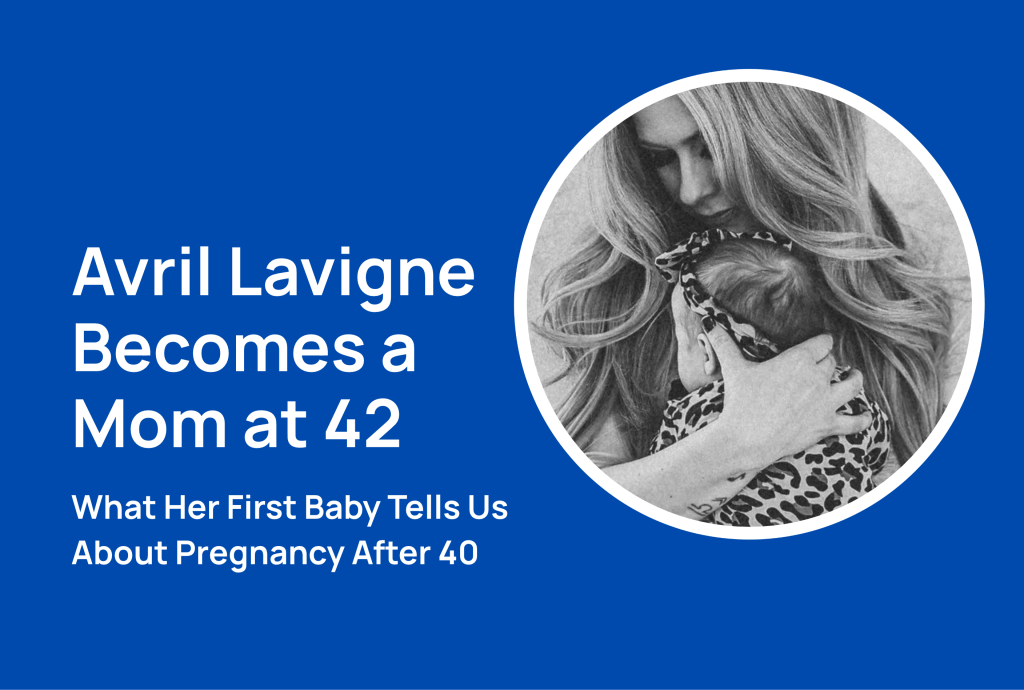
Avril Lavigne announced the birth of her first child, a baby girl, on Instagram on Friday, November 13, 2026, at age 42, as reported by the Associated Press and ABC News. The singer did not share the baby’s name, the father’s identity, or any details about how she conceived, and this article does not speculate about them.
What her announcement does offer is a timely reason to talk about something many of our clients live through quietly: becoming a mother for the first time after 40. Below we set out what is publicly known about the news, what national data says about first births after 40, how fertility changes with age, and which paths to parenthood exist for women in their forties.
What did Avril Lavigne announce on November 13, 2026?
Avril Lavigne, the Canadian singer behind “Complicated” and “Sk8er Boi”, revealed on November 13, 2026 that she had welcomed her first child, a daughter, in a three-photo Instagram carousel, according to The Canadian Press via CTV News. There had been no public pregnancy announcement beforehand, and the post was her first on Instagram in more than a year.

The caption, “Our Mini [expletive] Princess has arrived”, followed by bow, crown, bottle and heart emojis, was read by fans and the press as a nod to her 2007 hit “Girlfriend“.
The three photos in the Instagram post
The carousel contains three black-and-white images, as described by Good Morning America and the Associated Press. The first shows two adult hands holding the newborn’s tiny hand. The second shows Lavigne cradling her daughter, who wears a leopard-print onesie and a matching headband. The third shows three pairs of checkered Vans on a skateboard: two adult pairs and one baby pair.
Hello! Magazine reported that comments on the announcement were limited, so fans congratulated her under older posts instead. The same news was shared on her X account.
What she has not shared
As of November 19, 2026, Lavigne has not revealed her daughter’s name, the identity of the father, or whether the pregnancy involved fertility treatment, according to ABC News and TMZ. Every claim online about IVF, egg freezing or donor eggs in connection with this birth is speculation.
We think that silence deserves respect. A woman’s route to motherhood is her medical information, and the decision to share it belongs to her alone. That principle applies to a global star in exactly the same way it applies to every intended parent we work with.
How common is a first baby after 40 in the United States?
First and later births to US women in their early forties are rising, not rare: the US birth rate for women aged 40 to 44 increased 2% to 12.7 births per 1,000 women in 2024, according to the CDC’s National Center for Health Statistics. In the same year, birth rates fell for every age group from 15 to 34.
The longer trend is just as clear. A separate NCHS analysis found that the fertility rate for women 40 and older rose 24% between 2015 and 2024, from 5.8 to 7.2 births per 1,000 women aged 40 to 49. The CDC also notes that the 40 to 44 rate has risen almost continuously since 1985.
Why the trend matters for the conversation around Avril Lavigne
Lavigne’s announcement landed in a population where later motherhood is increasingly ordinary. Many women in her generation spent their twenties and thirties building careers, recovering from relationships that did not lead to children, or simply waiting for the right moment.
In a 2013 interview with E! News, at age 29, Lavigne said she wanted “one or two” children “eventually”, but not right away, as later recounted by The Blast. Thirteen years later, that “eventually” arrived. Her story is personal, but the timeline is one that the CDC data shows millions of women share.
What happens to female fertility after 40, according to ACOG and ASRM?
Female fertility declines gradually from about age 32 and more rapidly after age 37, according to ACOG and ASRM Committee Opinion No. 589, the joint guidance of the American College of Obstetricians and Gynecologists and the American Society for Reproductive Medicine. The same guidance advises women over 35 to seek a fertility evaluation after six months of trying, rather than the usual twelve.
The decline is not a cliff at a single birthday, and it varies a great deal between individuals. Still, by the early forties both the number of eggs and the share of eggs with a normal set of chromosomes are noticeably lower than a decade earlier.
Egg quantity versus egg quality
Two separate things change with age, and it helps to keep them apart. Quantity, often called ovarian reserve, is the number of eggs remaining and is estimated with an AMH blood test and an ultrasound count of antral follicles. Quality is mostly about chromosomes: whether an egg divides correctly when it matures.
A woman can have a reassuring AMH result at 42 and still face lower odds per egg, because AMH measures how many eggs are left, not how well they will develop. This is one of the most common sources of confusion we hear in first consultations.
Why chromosomes matter more than the calendar
The main reason IVF success falls with age is chromosomal error in eggs, a finding summarised in a 2013 multicenter study in Fertility and Sterility by Harton and colleagues. In that study, aneuploidy rates in blastocysts rose from 32% to 85% across the maternal age range examined.
The same study found that when a chromosomally normal embryo was transferred, implantation and pregnancy rates were not significantly different between younger and older patients up to age 42. In plain terms, the uterus of a woman in her early forties is usually still able to carry a pregnancy. The harder part is producing a chromosomally normal embryo from her own eggs.
Age also affects how many embryos keep developing in the lab. A 2025 analysis of 25,974 embryos published in Aging-US found that the share of embryos that stopped growing before the blastocyst stage rose from 33% in women under 35 to 44% in women over 42.
IVF success rates by age: what SART’s 2022 national data shows
For women using their own eggs, 13.0% of intended egg retrievals at ages 41 to 42 led to a live birth in 2022, falling to 4.5% above age 42, according to the Society for Assisted Reproductive Technology’s 2022 national summary. These figures count every embryo transfer from that retrieval, fresh and frozen.
| Age of woman (own eggs) | Live births per intended egg retrieval, SART 2022 |
|---|---|
| Under 35 | 53.5% |
| 35 to 37 | 39.8% |
| 38 to 40 | 25.6% |
| 41 to 42 | 13.0% |
| Over 42 | 4.5% |
How to read “per intended retrieval”
“Per intended retrieval” means SART starts counting when a woman begins a stimulation cycle with the plan of collecting eggs. Cycles that are cancelled before collection still count in the denominator, and every embryo created in that cycle is followed through all of its transfers.
This makes it one of the most honest measures available, because it reflects the whole journey of one cycle rather than the best moment within it. When a clinic quotes a much higher number, ask which denominator it uses: per transfer, per embryo, or per patient across several cycles.
Where the averages mislead
National averages describe groups, not individuals. A 42-year-old with strong ovarian reserve and no other diagnoses may do better than the average for her age band, and a 39-year-old with very low reserve may do worse.
The “over 42” category is also very wide. Researchers writing in Reproductive Biology and Endocrinology in 2023 noted that 11,725 retrieval cycles, 8.7% of all US retrieval cycles in 2018, were performed for patients over 42, and they split that group by single year of age because outcomes at 43 and at 46 differ sharply. Treat any single headline percentage as a starting point for a conversation with your doctor, never as a forecast.
The paths to a first baby after 40
Women who become first-time mothers after 40 generally take one of four routes: natural conception, IVF with their own fresh eggs, IVF with eggs frozen at a younger age, or IVF with donor eggs or embryos, and SART’s 2022 data shows these routes carry very different odds. Which route fits depends on age, ovarian reserve, medical history and personal values.
None of these routes is more “real” than another, and none is a guarantee. Below is a short, practical description of each.
Conceiving naturally or with your own eggs after 40
Natural conception after 40 does happen, and the CDC birth data above shows it happens more every year. If it is not happening within six months, the ACOG and ASRM guidance supports moving promptly to an evaluation rather than waiting.
IVF with your own eggs is the natural next step for many women, often combined with preimplantation genetic testing for aneuploidy (PGT-A) so that only chromosomally normal embryos are transferred. The SART 2022 figures in the table above show why some women in their early forties plan for more than one retrieval from the start.
Using eggs frozen at a younger age
Eggs keep the biological age they had on the day they were frozen. A woman who froze eggs at 34 and uses them at 42 is, in terms of egg quality, working with 34-year-old eggs, although results still depend on how many eggs were frozen and the lab that froze and thawed them.
For women who are still in their thirties and reading this article because Avril Lavigne’s story made them think about their own timeline, a fertility check-up and an honest conversation about egg freezing may be the most useful next step.
Using donor eggs over 40
With donor eggs, success tracks the age of the donor rather than the age of the intended mother. SART’s 2022 national summary reports live birth rates of roughly 39% for both fresh and frozen donor-egg recipient cycles, and these figures are not broken down by the recipient’s age because her age has relatively little effect on the outcome.
That is the practical meaning of the Harton study above: if the chromosomal quality of the egg is restored by using a younger donor, a uterus in its forties is usually able to do its part. Donor eggs are the route Sunshine Egg Donation Agency specialises in, and we describe the decision in more detail below.
Why donor eggs change the age equation for women over 40
Donor eggs separate the age of the egg from the age of the mother, and that is why women over 40 use them far more often than younger patients: 20.6% of women over 40 who used assisted reproduction in 2022 used donor eggs or embryos, according to a USAFacts analysis of CDC data. Assisted reproduction overall accounted for about 2.6% of all US births that year, per the CDC’s National ART Surveillance System.
The mother who carries a donor-egg pregnancy is the biological mother in the sense that matters for gestation: she nourishes the baby for nine months, and her body shapes the pregnancy. Genetically, the child inherits the donor’s DNA and the partner’s DNA, if the partner’s sperm is used.
What changes emotionally with donor eggs
For many women the medical decision is easier than the emotional one. Letting go of a genetic connection can involve grief, and that grief is legitimate even when the decision is clear.
Counselling before treatment helps couples work through that grief and talk about what they will tell family and, later, the child. It is worth asking any clinic whether a counsellor is part of the programme.
Why open donor profiles matter to many intended parents
Sunshine works with open, non-anonymous donors, which means intended parents can see photos and real profiles and choose a donor who resembles them or shares their background. For many women over 40 this makes the choice feel personal rather than abstract.
Openness also helps later. Families who plan to tell their child about donor conception, as the ASRM Ethics Committee encourages, can describe a real person rather than an anonymous code.
Privacy and the right not to explain: what Avril Lavigne’s announcement models
Avril Lavigne shared a joyful announcement on November 13, 2026 while keeping the father’s identity, her daughter’s name and every medical detail private, as noted by ABC News, the Associated Press and Global News. That combination, public happiness with private details, is a healthy model for anyone becoming a parent after 40.
Women who conceive later in life are often asked intrusive questions: “Was it IVF?”, “Are they your eggs?”, “How old were you?”. None of these questions requires an answer. Families who used donor eggs can decide whom to tell, when, and in what words. The ASRM Ethics Committee strongly encourages telling the child about donor conception, while stating that the final choice belongs to the parents. Nobody else is owed that conversation.
Online speculation and why it hurts
Within hours of the announcement, social media filled with theories about how Lavigne conceived. Whatever the truth, that kind of speculation sends a message to every woman going through treatment: that her body and her choices are public property.
Our position is simple. No route to motherhood needs to be justified, and no woman owes the internet her medical history.
What a first fertility consultation after 40 should cover
A useful first fertility consultation after 40 covers four things, consistent with the expedited evaluation that ACOG and ASRM Committee Opinion No. 589 recommends for women over 35: ovarian reserve, sperm, the uterus, and a realistic plan with timelines and budget. Bring any previous test results and a list of your questions.
Tests worth asking about
- AMH and an antral follicle count by ultrasound, to estimate ovarian reserve.
- A semen analysis for a male partner, since sperm quality affects every route except donor embryos.
- A uterine assessment, such as ultrasound or hysteroscopy, to check for polyps, fibroids or other issues that affect implantation.
- General health checks your doctor recommends before pregnancy at this age, including blood pressure and blood sugar.
Questions to ask the clinic
Ask which denominator their success rates use, how many of their patients are over 40, what share of their over-40 patients use donor eggs, and what happens if a cycle produces no chromosomally normal embryos. A clinic that answers these questions plainly is usually a clinic that will treat you plainly.
If donor eggs are on the table, ask how donors are screened, whether profiles are open, and how frozen versus fresh donor cycles compare at that clinic.
Where the comparison with celebrity pregnancies stops working
Celebrity pregnancies after 40 are not evidence of what is typical: Avril Lavigne, like most public figures, has disclosed nothing about her path to motherhood, per ABC News, so the public sees the outcome and never the route. A single happy announcement cannot tell anyone what their own chances are.
There are three specific traps. Survivorship: we hear about the women who succeeded, not those who tried for years without a baby. Missing information: a 42-year-old celebrity may have frozen eggs in her thirties, used donor eggs, conceived naturally, or anything in between, and the public has no way of knowing. Resources: unlimited budgets and private care do not change biology, but they do change how many attempts a woman can afford.
None of this diminishes Lavigne’s joy, or anyone else’s. It simply means the useful lesson is not “it happened for her, so it will happen for me”, but “it is worth getting real information about my own situation now”.
Key takeaways about becoming a first-time mother after 40
Becoming a first-time mother after 40 is increasingly common and very achievable for many women, but success with your own eggs drops steeply in the early forties, falling to 13.0% per intended retrieval at ages 41 to 42 in SART’s 2022 data. Knowing that early gives you more options, not fewer.
- Avril Lavigne announced her first child, a daughter, on November 13, 2026, at 42, and has kept every medical detail private.
- The US birth rate for women aged 40 to 44 rose to 12.7 per 1,000 in 2024, per the CDC.
- Fertility declines from about 32 and faster after 37, per ACOG and ASRM; women over 35 should seek evaluation after six months of trying.
- Chromosomal quality of eggs, not the uterus, is the main reason IVF success falls with age.
- Donor eggs largely remove the effect of the intended mother’s age on success rates.
- How you became a mother is yours to share or to keep.
Frequently asked questions about pregnancy after 40
The answers below draw on CDC, SART and ACOG/ASRM data cited in this article and on public reporting about Avril Lavigne’s announcement as of November 19, 2026.
How old is Avril Lavigne, and when was her baby born?
Avril Lavigne was 42 when she announced the birth of her first child, a daughter, on Instagram on November 13, 2026, according to the Associated Press and ABC News. She was born on September 27, 1984. She has not shared her daughter’s exact birth date, her name, or the identity of the father.
Did Avril Lavigne use IVF or donor eggs?
There is no public information about how Avril Lavigne conceived. As of November 19, 2026, neither she nor her representative has commented on fertility treatment, according to ABC News reporting on the announcement. Any claim that she used IVF, frozen eggs or donor eggs is speculation, and Sunshine Egg Donation Agency does not suggest otherwise.
What are the chances of getting pregnant at 42 with your own eggs?
With IVF using her own eggs, a woman aged 41 to 42 had a 13.0% chance of a live birth per intended egg retrieval in 2022, according to SART’s national summary. Above 42 the figure was 4.5%. Individual chances vary with ovarian reserve and health, so personal testing matters more than averages.
Why does IVF success drop so sharply after 40?
IVF success drops after 40 mainly because more eggs carry chromosomal errors, not because the uterus stops working. A 2013 Fertility and Sterility study by Harton and colleagues found blastocyst aneuploidy rising from 32% to 85% with maternal age, while chromosomally normal embryos implanted at similar rates up to age 42.
How successful is IVF with donor eggs for women over 40?
Donor-egg IVF led to a live birth in roughly 39% of recipient cycles, fresh or frozen, in SART’s 2022 national summary, and the data is not split by recipient age. Success depends mainly on the donor’s age and egg quality, which is why donor eggs are widely used by women over 40.
How do I find a trustworthy egg donor agency?
Look for an agency that shows real, verifiable donor profiles, explains its medical screening in writing, works with licensed partner clinics, and quotes success rates with a clear denominator. Sunshine Egg Donation Agency works with open, non-anonymous donors and partner clinics in countries including Georgia, Cyprus, Mexico, Malaysia and Thailand.
When should a woman over 40 see a fertility specialist?
A woman over 40 who wants a baby can see a fertility specialist straight away, without waiting to try for a set period. ACOG and ASRM Committee Opinion No. 589 recommends expedited evaluation after six months of trying for women over 35, and many specialists advise women over 40 to seek help sooner.
Is a celebrity pregnancy at 42 a good guide to my own chances?
Not directly. A celebrity announcement shows an outcome but not the path, the number of attempts, or the method used, and Avril Lavigne has disclosed none of these. National data from the CDC and SART, combined with your own test results, gives a far more reliable picture of your personal chances.
Sources: Associated Press; The Canadian Press / CTV News; ABC News / Good Morning America; Hello! Magazine; CDC National Center for Health Statistics; Society for Assisted Reproductive Technology; ACOG and ASRM Committee Opinion No. 589; Fertility and Sterility (Harton et al., 2013); Reproductive Biology and Endocrinology (Seifer et al., 2023); Aging-US (2025); USAFacts.