Fresh vs Frozen Donor Eggs: Success Rates, Costs and Timelines in 2026
Choosing between fresh and frozen donor eggs is one of the first major decisions in a donor-egg IVF journey, and it is a decision that careful, well-informed intended parents want to get right. Fresh eggs may offer a small statistical advantage in some treatment combinations. Frozen eggs are usually faster to start, easier to plan around international travel, and, according to newer research, increasingly comparable in outcome.
So which option is “better”? The honest answer in 2026 is: it depends on which outcome you are measuring, how many embryo transfers you count, and what matters most for your own timeline, budget and family plans. This guide walks through what the largest available studies actually show, what ASRM’s official practice guideline says, and what fresh vs. frozen donor eggs mean in practice for intended parents travelling from Europe, Australia, Singapore, Canada and India.

Consultation scene showing a couple discussing donor egg options
What is the Difference Between Fresh and Frozen Eggs?
Fresh donor eggs are fertilised within hours of retrieval, while frozen donor eggs are vitrified, stored in a donor-egg bank, and thawed when the recipient is ready for treatment. The core difference is therefore the timing of egg retrieval, fertilisation and embryo transfer — not the fundamental IVF process itself.
In a fresh donor cycle, the donor undergoes ovarian stimulation and egg retrieval specifically for the intended parents, and the eggs are fertilised shortly afterwards. With frozen donor eggs, the eggs have already been retrieved and preserved using vitrification, an ultra-rapid freezing technique, then thawed and fertilised when the parents and clinic are ready.
It also helps to separate the egg from the embryo:
- A fresh egg may result in a fresh or a frozen embryo.
- A frozen (thawed) egg may also result in a fresh or a frozen embryo.
- Embryos are commonly frozen when genetic testing (PGT-A) is planned or when the transfer needs to happen later.
What Do the Large Success-Rate Studies Show?
The most frequently cited data set comes from a national analysis of 135,085 donor-oocyte cycles performed in U.S. clinics between 2018 and 2020, published in Fertility and Sterility in 2024. The study compared four combinations: fresh or frozen eggs, each followed by either a fresh or a frozen embryo transfer.
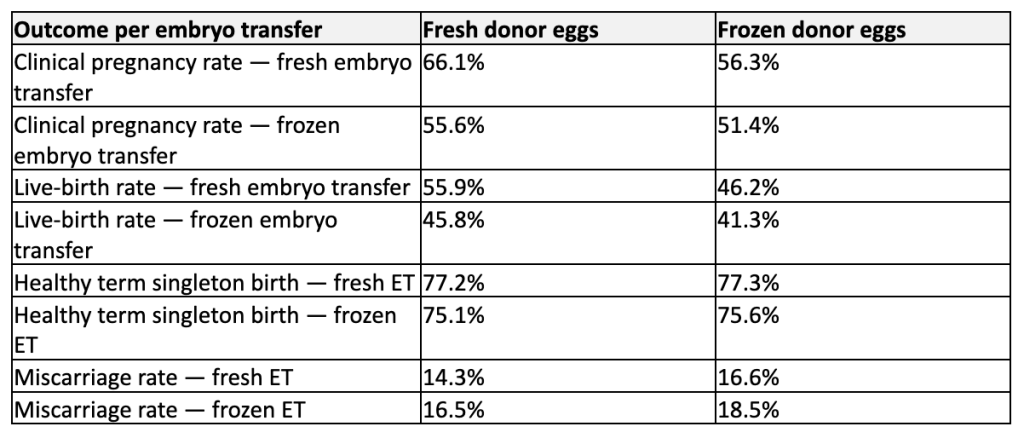
Source: analysis of 135,085 U.S. donor-oocyte embryo transfer cycles, 2018–2020, published in Fertility and Sterility (2024). Figures are population-level results per embryo transfer and cannot predict an individual patient’s outcome.
Fresh eggs show an advantage in this data set, particularly when paired with a fresh embryo transfer. But the gap should be read carefully: donor age, sperm quality, embryo quality, laboratory performance, the recipient’s uterine health and the number of eggs available can all influence the final result just as much as the fresh/frozen status of the egg itself.
Why One Database Analysis Isn‘t the Final Word?

An embryologist examining vitrified donor eggs in a modern IVF laboratory
A large registry study is powerful for spotting population-level trends, but it cannot control for every variable. Recipients who chose fresh donor cycles and those who chose frozen egg banks are not always medically identical groups, and the number of eggs available per cycle differs structurally: frozen donor eggs are typically sold in cohorts of about six, while a fresh cycle usually gives access to the donor’s full retrieval. More eggs generally means more embryos and more chances to select one for transfer, independent of whether the egg itself was fresh or frozen.
A 2025 Study Found the Gap Narrows Once You Count Every Transfer
A 2025 cohort study from a Greek fertility centre compared 112 fresh and 102 vitrified donor-oocyte cycles and looked at cumulative outcomes rather than a single transfer. Live-birth rates after the first embryo transfer were similar (59.8% fresh vs. 58.8% vitrified), and cumulative live-birth rates — counting second and third transfers from the same cohort — were 69.6% for fresh eggs and 66.7% for vitrified eggs, a difference that was not statistically significant.
The takeaway is not that the two 2024 and 2025 studies contradict each other — they measure different things. Per single transfer, large national data still show a modest fresh-egg advantage. Per completed treatment plan, once multiple transfers from a cohort are counted, the outcome gap between fresh and frozen becomes much smaller, and in some single-centre data disappears.
Why Can the Results Differ Between Fresh and Frozen Eggs
The difference is a mix of biology and treatment logistics rather than one simple cause:
- Cohort size: a frozen batch is usually smaller than a full fresh retrieval, which can mean fewer embryos to choose from.
- Freeze-thaw attrition: a small proportion of eggs may not survive warming, even with modern protocols.
- Selection effects: clinics and patients choosing a fresh programme are not always comparable to those choosing a bank.
“We tell intended parents to look past the fresh-vs-frozen label and ask about the specific cohort in front of them — how many eggs, what age the donor was at retrieval, and whether genetic testing is planned. Those details usually explain more about their odds than the fresh/frozen category alone,”
— says Dr. Elena Popova, reproductive specialist working with Sunshine Egg Donation Agency.
Modern vitrification has substantially reduced freeze-thaw losses. At specialist clinics, blastocyst survival after warming now regularly exceeds 97%, and one clinic reports that more than 85% of its donor-egg transfers are now frozen transfers by choice, not necessity. The old assumption that “frozen always means worse” no longer matches the evidence: it means a modest, shrinking statistical gap that must be weighed against cost, speed and predictability.
What Does ASRM Say About Fresh vs Frozen Donor Eggs?
The ASRM Practice Committee’s evidence-based guideline reports moderate evidence that pregnancy rates per transfer between fresh and previously vitrified donor oocytes are not significantly different, while also noting that evidence remains more limited for some neonatal and long-term outcomes.
For patients, this means success-rate marketing should not be the only reason to choose a fresh programme. Before deciding, ask the clinic or agency to explain:
- Which outcome is being quoted: pregnancy, implantation, or live birth.
- Whether the figures are per embryo transfer or per completed treatment cycle.
- How many eggs are included in a frozen cohort.
- Whether embryo genetic testing (PGT-A) is planned.
- What happens if fewer embryos develop than expected.
A consultation with a reproductive specialist is essential, because clinic-specific laboratory results can matter more than a general national average.
What Matters Most for International Intended Parents?

International intended parents comparing donor egg timelines and travel plans on a laptop at home
For parents travelling from Europe, Australia, Singapore, Canada or India, timing and travel logistics can matter as much as the statistics above. A fresh donor cycle usually requires coordinating several stages:
- Selecting and reserving a donor.
- Synchronising the donor’s and recipient’s treatment schedules.
- Stimulating the donor and monitoring follicle development.
- Waiting for the egg retrieval.
- Fertilising the eggs and creating embryos.
- Remaining available in case the timetable shifts.
If the donor responds differently than expected, produces fewer eggs, or has a cancelled cycle, the whole schedule can move. Frozen donor eggs are already stored in a bank, so they do not require synchronisation with a donor’s live cycle and can usually be scheduled more predictably — which can shorten time spent abroad and simplify flights, work leave and accommodation.
How Much Do Fresh and Frozen Donor-Egg Programms Cost?
Fresh donor cycles are generally more expensive because they involve donor stimulation, monitoring, retrieval, synchronisation and real-time coordination, plus the risk of added cost if a cycle is delayed or cancelled. Frozen donor eggs can reduce some unpredictable expenses because the eggs are already retrieved and stored, making the embryo-creation stage easier to plan and price in advance.
The total price still depends heavily on the clinic and country. Ask whether the quoted fee includes:
- Donor compensation and medical screening.
- The number of frozen eggs in the cohort.
- Egg warming and fertilisation.
- ICSI, embryo culture and blastocyst development.
- Embryo freezing and storage.
- Genetic testing, if required.
- Medication, monitoring and embryo transfer.
- International coordination and additional travel.
A lower headline price does not always mean a lower total cost — ask for a written estimate covering the complete programme.
How Should You Choose Between Fresh and Frozen Donor Eggs?
There is no universal best option. The right choice depends on your medical situation, family plans, budget and preferred timeline.
Fresh eggs may suit you if:
- You want access to the full number of eggs retrieved from a selected donor.
- You prioritise maximising the number of embryos available.
- You are comfortable with a longer, less predictable schedule.
- You may wish to establish closer donor matching, where permitted.
- You can remain in the treatment country for the required period.
Frozen eggs may suit you if:
- You want to start treatment sooner.
- You need a predictable schedule for international travel.
- You prefer a clearly defined treatment package.
- You want to avoid donor-cycle synchronisation.
- You value convenience and lower exposure to cancellation or retrieval variability.
Before deciding, ask your clinic or agency for its own live-birth rates for fresh and frozen donor eggs, per embryo transfer, broken down by patient age and genetic-testing status — clinic-level numbers are usually more useful than a national average.
How Fresh vs Frozen Donor Eggs: What We Know in 2026
Does a fresh donor cycle give a small statistical edge in live-birth rate per transfer? Yes. In the largest available U.S. data set (135,085 cycles), fresh oocyte + fresh embryo transfer had a 55.9% live-birth rate versus 46.2% for frozen oocyte + fresh embryo transfer.
Does that mean frozen donor eggs are a poor choice? No. ASRM’s own guideline finds pregnancy rates per transfer are not significantly different between fresh and previously vitrified donor oocytes, and a 2025 cohort study found statistically similar cumulative live-birth rates (69.6% vs. 66.7%) once repeat transfers were counted.
Is the baby’s health different with frozen donor eggs? No meaningful difference has been shown — rates of healthy term singleton birth are close to 75–77% in both groups.
Is modern vitrification reliable? Yes. Blastocyst survival after warming now regularly exceeds 97% at specialist clinics.
Are frozen donor-egg programmes usually faster for international parents? Usually, yes — because there is no need to synchronise with a donor’s live stimulation cycle.
Are fresh donor programmes usually more expensive? Usually, yes, due to added coordination, monitoring and cancellation risk.
Is one option definitively “better” for every patient? No. The right choice depends on age, embryo-testing plans, budget and travel constraints — a reproductive specialist can translate general statistics into a plan for your specific situation.
FAQ: Fresh vs Frozen Donor Eggs
FAQ: Fresh vs Frozen Donor Eggs
What gives a better chance of having a baby: fresh or frozen donor eggs?
Fresh donor eggs followed by a fresh embryo transfer showed a 55.9% live-birth rate compared with 46.2% for frozen donor eggs followed by a fresh embryo transfer, in an analysis of 135,085 U.S. donor-egg cycles. The difference was statistically significant per transfer, but a 2025 study found the gap narrows once cumulative transfers are counted.
Is the baby’s health different with frozen donor eggs?
Available analyses found very similar rates of healthy term singleton births — around 75–77% for both fresh and frozen eggs. These are population-level figures; individual outcomes depend on many medical factors.
What does ASRM say about donor-egg cryopreservation?
ASRM guidance does not identify a statistically significant difference in pregnancy rates per transfer between fresh and cryopreserved donor oocytes, while noting more limited evidence for some neonatal outcomes.
How reliable is modern vitrification?
Very reliable. Specialist-clinic data report blastocyst survival after warming above 97%, though results can differ between laboratories.
Why can frozen donor programmes be faster for international parents?
Frozen eggs are already stored and do not require synchronisation with a donor’s current cycle, which makes it easier to schedule fertilisation and embryo transfer around flights, work and personal commitments.
Are fresh donor programmes more expensive?
Usually, yes. Fresh programmes involve donor stimulation, monitoring, retrieval and cycle coordination. Frozen programmes can reduce some variable costs, though the final price depends on the clinic, country and services included.
How many eggs are typically included in a frozen donor-egg cohort?
Frozen donor eggs are commonly sold in cohorts of around six, whereas a fresh cycle usually provides access to the donor’s full retrieval, which can mean more embryos to choose from.
Does the number of eggs matter more than the fresh-vs-frozen label itself?
Often, yes. The number of mature eggs, the donor’s age at retrieval and whether genetic testing is planned tend to influence the odds of success at least as much as whether the eggs were fresh or frozen.
Is the gap between fresh and frozen donor eggs shrinking over time?
Yes. Improvements in vitrification and laboratory protocols have narrowed the historical difference, and newer single-centre data show cumulative outcomes that are close to equivalent.
Final Thoughts
The research on fresh vs. frozen donor eggs is a good example of why a single statistic rarely tells the whole story. Large national data show a real, modest advantage for fresh eggs per single embryo transfer. Smaller, more recent cohort data suggest that advantage shrinks — and can disappear — once a full treatment plan with multiple transfers is considered.
For intended parents, the sensible approach is to look past the fresh/frozen label: ask about cohort size, donor age, laboratory-specific outcomes, genetic-testing plans and your own timeline and budget, and weigh all of it together with a specialist who knows your medical history.
If you are weighing fresh vs. frozen donor eggs and would like to compare programmes, timelines and donor profiles, Sunshine Egg Donation Agency offers personalised consultations to help intended parents from Europe, Australia, Singapore, Canada and India choose a donor-egg path that fits their medical situation, budget and travel plans. Contact the Sunshine Egg Donation Agency team for a consultation about selecting a donor and planning your donor-egg programme.
Sources and Further Reading
- Trends and outcomes of fresh and frozen donor oocyte cycles in the United States — Fertility and Sterility (2024)
- Success rates: fresh vs. frozen donor eggs — Cofertility summary
- Comparison of cumulative live-birth rates between fresh and vitrified donor oocytes — Cureus (2025)
- Evidence-based outcomes after oocyte cryopreservation for donor oocyte IVF — ASRM Practice Committee guideline (2021)
- Vitrification (flash freezing) explained — NGC Clinic (2026)
- Sunshine Egg Donation Agency blog
Medically reviewed by Dr. Elena Popova, reproductive specialist
Published: September 2026 | Last updated: September 2026
Medical disclaimer: This article is for general educational purposes and does not replace advice from a qualified fertility specialist. Success rates vary between clinics and patients. Confirm current medical, legal and travel requirements before beginning an international programme.