Cameron Diaz Became a Mother at 47 and 53: The Science of Pregnancy After 40
Cameron Diaz became a mother for the first time at 47 and welcomed her third child at 53. Her story has drawn attention to pregnancy after 40, but a celebrity birth cannot be used as a fertility statistic.
In May 2026, Diaz and her husband, musician Benji Madden, announced the birth of their third child, a son named Nautas Madden. The couple had previously welcomed daughter Raddix in December 2019 and son Cardinal in March 2024. The family keeps its reproductive and medical history private, so important details about how each pregnancy was achieved have not been publicly confirmed.

Cameron Diaz at the WWD Style Awards 2026. Photo by Kevin Paul, licensed under CC BY 4.0 via Wikimedia Commons. Wikimedia Commons | CC BY 4.0
That distinction matters. A woman giving birth at 53 is not the same medical question as a 53-year-old woman conceiving and carrying a pregnancy with her own eggs. IVF, previously frozen eggs or embryos, donor eggs, and gestational surrogacy can all change the biological and medical circumstances.
Diaz’s experience is therefore best understood as a starting point for a broader question: what does modern reproductive medicine actually say about becoming a parent after 40?
Cameron Diaz’s Journey to Motherhood
Cameron Diaz married Benji Madden in 2015. In December 2019, the couple announced the birth of their daughter, Raddix. Diaz was 47.
In March 2024, they announced their second child, a son named Cardinal. In May 2026, Madden announced the arrival of their third child, Nautas Madden, when Diaz was 53. Major media outlets reported the birth announcement, while the couple continued to protect their children’s privacy.
Public reporting has discussed surrogacy in connection with the family’s earlier births. However, the couple has not released a complete medical account of their reproductive treatment, and reporting about the third child has not established every detail of conception or pregnancy.
For fertility education, this is an important boundary. It is reasonable to report the ages at which Diaz became a mother. It is not reasonable to infer that she conceived naturally at 53, used her own eggs, used donor eggs, underwent IVF, or used a gestational carrier unless a reliable source confirms that specific fact.
Can Women Get Pregnant After 40?
Yes, pregnancy after 40 is possible, but fertility declines with age because both the number and chromosomal competence of available eggs decrease, and the American Society for Reproductive Medicine (ASRM) identifies female age as a major predictor of reproductive potential.
Menstrual cycles can continue during the 40s even while reproductive potential is falling. Ovulation and menstruation therefore do not tell the whole story about egg quality.
A useful way to understand reproductive ageing is to separate ovarian ageing from pregnancy health. Ovarian ageing affects the eggs available for conception. Pregnancy at an older age introduces a different set of considerations involving the cardiovascular system, blood pressure, metabolism, placenta, and the developing fetus.
Dr. Valerie Baker, director of the Division of Reproductive Endocrinology and Infertility at Johns Hopkins, explains the basic mechanism simply: “Egg quality goes down with age.”
The practical implication is that someone over 40 should not assume that regular periods mean fertility is unchanged. Age, ovarian reserve, reproductive history, partner factors, and uterine health all contribute to the clinical picture.
What National Fertility Data Tell Us About Age and IVF Success
Fertility data from national registries show just how sharply success rates decline with age when a woman uses her own eggs.
The UK Human Fertilisation and Embryology Authority (HFEA) reported that in 2023, the preliminary average birth rate per fresh embryo transferred was 35% for patients aged 18–34 and 5% for patients aged 43–44 using their own eggs. These figures describe UK treatment outcomes, not an individual’s personal probability, and the 2023 birth data were still preliminary.
US data tell a similar story. The CDC’s 2022 national ART summary reports treatment use across age groups and provides national outcome data for assisted reproductive technology, consistently showing that age is a major factor in IVF success.
The gap between these age groups, from 35% down to 5%, illustrates why a fertility specialist’s individual assessment matters more than any headline number.
Why Egg Quality Matters More Than Age on Paper in IVF After 40
Egg quality matters because an embryo needs the correct number of chromosomes to develop normally. With increasing maternal age, errors in chromosome separation become more common, increasing the proportion of embryos with aneuploidy.
Reviews published in 2024 and 2025 describe ovarian ageing as involving both declining oocyte quantity and declining oocyte quality. Researchers are studying mechanisms that include changes in chromosome cohesion, spindle function, DNA damage, and mitochondrial function.
These biological changes help explain why IVF cannot simply reset the reproductive clock. When a woman uses her own eggs, the eggs retain the biological characteristics associated with her age.
There is currently no proven treatment that reverses age-related decline in egg chromosomal competence. Some treatments may improve specific aspects of fertility care, but they should not be presented as a way to restore eggs to the biological state of a younger woman.
Donor eggs address this specific problem differently. If the egg comes from a younger screened donor, the biological age of the egg is linked to the donor rather than the recipient. That can substantially change embryo-development prospects, while leaving the separate question of pregnancy health.
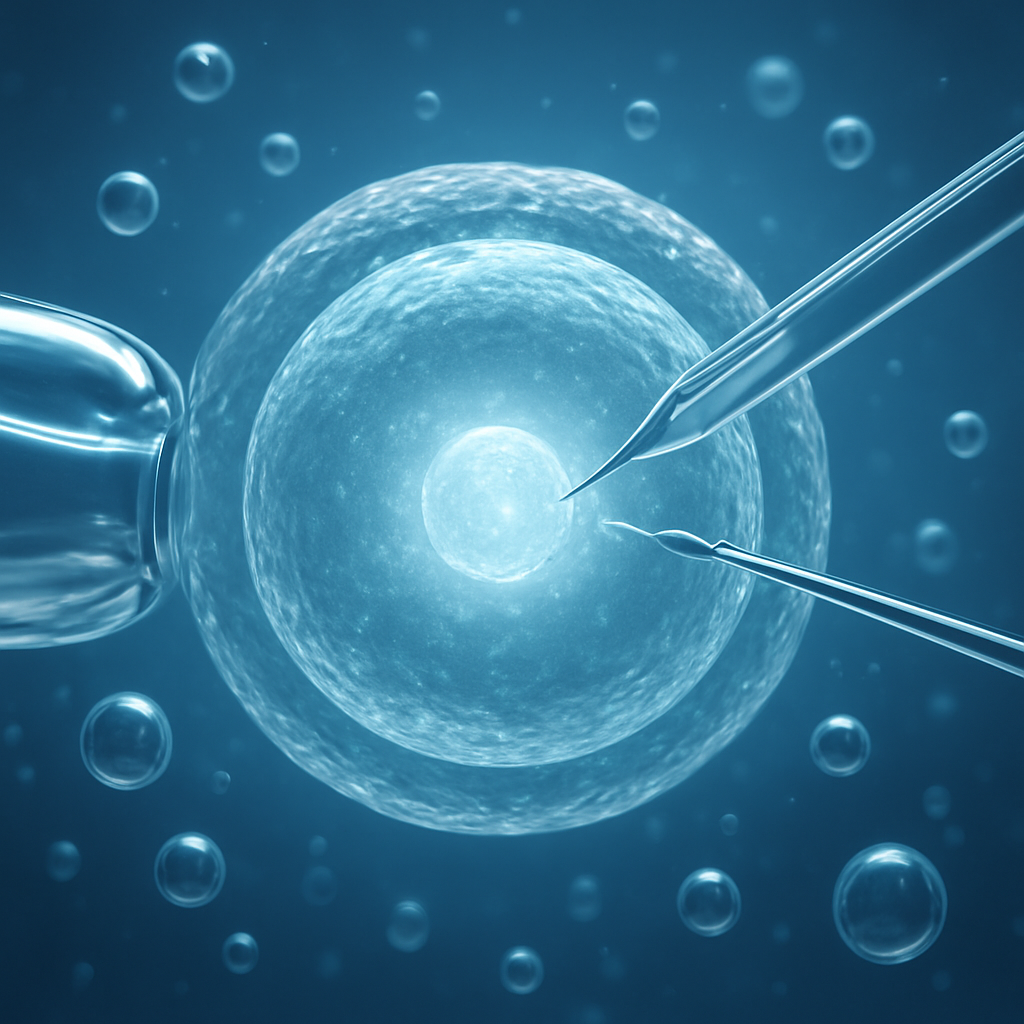
3D medical illustration of human egg cell fertilization, a visual representation of the IVF process discussed in this section, AI-generated
IVF After 40: What Changes?
IVF can help overcome some causes of infertility after 40, but IVF using a woman’s own eggs cannot completely reverse age-related changes in egg quality.
With increasing age, treatment may involve fewer retrieved eggs, fewer embryos reaching the blastocyst stage, a higher proportion of chromosomally abnormal embryos, a higher risk of miscarriage, and a lower probability of live birth per treatment cycle.
Dr. Valerie Baker notes that IVF success needs to be individualized using factors such as age and ovarian reserve. She also explains that success rates decline substantially through the early 40s, with a different pattern when oocyte donation is used.
PGT-A may be discussed in some IVF situations because maternal age is associated with a higher likelihood of embryo aneuploidy. It is not a universal solution and does not make aneuploid embryos normal. ASRM’s 2024 committee opinion describes both potential uses and limitations of PGT-A.
What Happens When Donor Eggs Are Used?
Donor egg IVF changes the age-related equation by using an egg from a younger donor rather than an egg from the intended mother.
Because egg age is a major driver of embryo aneuploidy, using donor oocytes can largely bypass the decline in implantation and birth rates associated with ageing of the recipient’s own eggs. ASRM’s 2025 ethics opinion specifically describes oocyte donation as a way to circumvent much of this age-related decline and “largely restores pregnancy potential beyond menopause.”
“Donor eggs change the age of the egg, not the age of the patient,” says Dr. Elena Popova, reproductive specialist at Sunshine Egg Donor Agency. “We assess the uterus and the general medical picture separately, every time.”
Donor eggs do not mean that age becomes irrelevant. The recipient still needs an assessment of whether pregnancy is medically appropriate, including cardiovascular and metabolic health, blood pressure, uterine factors, and other conditions that may affect pregnancy.
ASRM’s 2024 guidance also recommends careful donor evaluation, including medical, genetic, infectious-disease, and psychological screening. Oocyte donors are preferably 21 to 34 years old under that guidance.
Two questions should therefore be kept separate: How old is the egg? And how medically prepared is the person who will carry the pregnancy?
Close-up of hands adjusting a microscope on a glass slide in a laboratory setting.
Photo by Edward Jenner: Free use by Pexels license
What Donor Egg IVF Cannot Change
Donor egg IVF cannot remove pregnancy-related risks associated with the recipient’s age or medical history. It also cannot guarantee implantation, pregnancy, or live birth.
Donor eggs do not automatically solve sperm-related infertility, uterine problems, or medical conditions that make pregnancy unsafe. They change one major biological variable: the age and quality of the egg used to create the embryo.
This distinction is particularly important when discussing donor eggs after 45 or after menopause. Donor oocytes may make pregnancy biologically possible in situations where the ovaries can no longer provide viable eggs, but a fertility clinic still has to determine whether embryo transfer and pregnancy are medically appropriate.
Does the Recipient’s Age Still Matter With Donor Eggs?
Yes, recipient age can still matter even when donor eggs are used, because egg age and pregnancy age are different biological questions.
A 2026 study published in the Journal of Assisted Reproduction and Genetics analysed 1,774 patients who underwent 2,760 single blastocyst transfers with donor oocytes. It found that recipient age remained associated with outcomes, with a clinically meaningful threshold identified at 49 years in the study population.
This finding should not be interpreted as a universal age cutoff. Donor egg IVF can remain an established treatment option at advanced reproductive ages, but individual outcomes vary and medical assessment remains essential.
ASRM’s 2025 opinion similarly separates the benefits of donor oocytes from the health risks of gestating at an advanced age. It notes that oocyte donation can largely circumvent age-related declines in implantation and birth rates while acknowledging that maternal and fetal risks can still be elevated.
What About the Father’s Age in IVF After 40?
Paternal age can also affect reproductive outcomes, although its effects are generally smaller and less predictable than the effects of female reproductive ageing.
ASRM’s 2025 guidance notes associations between advancing paternal age and changes in semen parameters, sperm DNA integrity, and the number of new genetic mutations in sperm. Some studies also report lower pregnancy or live birth rates with increasing paternal age.
At the same time, paternal age should not be presented as an automatic explanation for infertility or an individual outcome. Sperm concentration, motility, morphology, medical history, and other factors all matter.
When donor eggs are used, sperm factors remain relevant because the embryo still receives genetic material from the sperm source. A donor-egg cycle is therefore not a way to bypass every reproductive factor associated with age.
What About Donor Age and Egg Screening?
Donor age matters because the biological quality of an oocyte is related to the age of the woman who produced it.
ASRM’s 2024 gamete and embryo donation guidance says oocyte donors should preferably be 21 to 34 years old. It also recommends medical evaluation, genetic assessment, infectious-disease testing, psychological counseling, and assessment of ovarian response.
“Screening matters as much as the age on the profile,” says Anastasia Kochanova, Director of Donor Relations at Sunshine Egg Donor Agency. “A 24-year-old donor without a full genetic and psychological workup is not a safer choice than a 31-year-old with one.”
Donor screening is broader than simply checking a donor’s age. A responsible program evaluates medical history and relevant genetic and infectious risks and provides appropriate counseling. Screening reduces risk but cannot guarantee that every future health condition or genetic outcome can be predicted.
Research on frozen donor eggs also shows why it is useful to distinguish efficiency from efficacy. A large 2020 analysis of 35,654 sibling donor oocytes found that vitrified oocytes were less efficient overall because some did not survive warming, while reproductive outcomes became comparable with fresh oocytes when the number of oocytes available after warming was taken into account.
For recipients, this means a frozen donor-oocyte program should be evaluated not only by a headline success percentage, but also by donor selection, screening, laboratory performance, warming survival, embryo development, and the clinic’s own outcome data.
What Are the Medical Risks of Pregnancy After 45?
Pregnancy after 45 carries higher rates of several maternal, fetal, and obstetric complications, even though many older patients can still have good outcomes with appropriate care.
ACOG and the Society for Maternal-Fetal Medicine identify advancing age as a risk factor for adverse maternal, fetal, and neonatal outcomes. Their 2022 guidance notes increasing rates of conditions including gestational diabetes, preeclampsia, labor complications, and cesarean delivery as maternal age rises.
For patients aged 40 and older, ACOG recommends individualized management that may include additional fetal growth assessment and antenatal surveillance because of increased risks such as fetal growth abnormalities and stillbirth. The guidance also emphasizes that age alone is not an indication for cesarean delivery.
Before donor-egg IVF at an advanced age, a clinic may therefore consider blood pressure, cardiovascular health, metabolic health, medications, uterine anatomy, previous pregnancies, and other medical conditions. The exact evaluation depends on the patient and the clinic’s protocols.
These risks should not be confused with egg quality. Donor eggs can address age-related changes in the egg, but they cannot make a 50-year-old body physiologically equivalent to a 30-year-old body during pregnancy.
Does Cameron Diaz’s Story Mean Women Can Simply Wait Until 50?
No. Cameron Diaz’s experience shows that parenthood can happen later in life, but it does not show that women can safely or reliably postpone fertility decisions until 50.
Celebrity stories are unusual by definition. A public figure may have access to fertility specialists, donor eggs, previously frozen eggs or embryos, gestational surrogacy, or other reproductive options that are not visible to the public.
More importantly, Diaz has not publicly disclosed enough medical information to calculate her individual fertility pathway. Her age at the birth of a child does not tell us the age of the egg, whether IVF was used, whether a pregnancy was carried by Diaz, or which medical factors were involved.
The better lesson is to separate a person’s family story from population data. If someone hopes to have children later, an early fertility consultation can provide information about ovarian reserve, reproductive options, and the potential value of fertility preservation.
Waiting is not automatically wrong, but waiting without understanding the biological timeline can reduce the number of options available later.
What Options Are Available After 40?
Fertility options after 40 depend on ovarian reserve, reproductive history, sperm factors, uterine health, general health, and the person’s family-building goals. There is no single treatment that fits everyone.
IVF With Your Own Eggs
IVF with your own eggs remains an option for some women in their early 40s, but the expected success rate is strongly influenced by age and ovarian response. A fertility specialist can assess whether treatment is likely to provide a reasonable chance of live birth.
Egg Freezing Before 35
Planned oocyte cryopreservation preserves eggs at the biological age at which they are frozen. Earlier freezing can therefore provide a different reproductive option than attempting to retrieve and freeze eggs for the first time in the 40s. ESHRE’s 2025 ovarian stimulation guideline includes updated recommendations relevant to elective oocyte cryopreservation and oocyte donation.
Donor Egg IVF After 40
Donor egg IVF can be considered when the intended mother’s own eggs are unlikely to provide a reasonable chance of success, including at more advanced reproductive ages. The embryo is created with a screened donor oocyte and sperm from the intended father or a sperm donor.
Gestational Surrogacy When Pregnancy Is Contraindicated
Gestational surrogacy addresses the ability to carry a pregnancy rather than the biological age of the egg. It may be considered when pregnancy is medically contraindicated or impossible, subject to local medical and legal requirements.
What Can We Learn From Cameron Diaz?
The most useful lesson from Cameron Diaz’s story is not that age does not matter. It is that family-building does not follow one universal timeline.
Some people become parents in their 20s or 30s. Others build families in their 40s or later. Some use IVF with their own eggs, some use donor eggs, and some need a gestational carrier.
Modern reproductive medicine has created more pathways to parenthood than previous generations had available. But those options are not equally effective at every age, and they do not remove every medical risk.
Evidence-based planning means understanding what age changes, what donor eggs can change, and what they cannot. It also means recognizing that an individual’s medical situation can differ substantially from a celebrity’s story.
That is why fertility care should begin with personal assessment rather than comparison with a headline.
What to Ask at Your First Fertility Consultation
A fertility consultation can turn general information about pregnancy after 40 into a plan tailored to the individual. Useful questions include:
- What does my ovarian reserve testing suggest?
- What are my realistic chances with my own eggs?
- Would donor eggs materially change my expected chances?
- Do I need additional testing before IVF?
- Would PGT-A be appropriate in my situation?
- Are there medical risks that I should address before pregnancy?
- If I am considering donor eggs, what donor screening and matching options are available?
Frequently Asked Questions About Cameron Diaz and Motherhood After 40
How old was Cameron Diaz when she had her first child?
Cameron Diaz was 47 when she and Benji Madden announced the birth of their daughter Raddix in December 2019. Their second child, Cardinal, was announced in March 2024, and their third child, Nautas, was announced in May 2026, when Diaz was 53.
Did Cameron Diaz use IVF?
Public reporting has discussed fertility treatment and surrogacy, but Diaz and Madden have not publicly confirmed the complete medical details of how their children were conceived or carried. It is therefore not possible to state as fact that IVF was used for a specific child.
Did Cameron Diaz use donor eggs?
There is no reliable public confirmation that Diaz used donor eggs. Her age at the birth of a child does not establish the age or source of the egg used.
Can a woman get pregnant naturally after 40?
Yes, natural pregnancy after 40 is possible, but fertility declines substantially with age as egg number and chromosomal competence decrease. A fertility evaluation can provide a more useful assessment than age alone.
Can donor eggs help women over 40?
Yes. Donor eggs bypass the age-related decline tied to a woman’s own eggs, and ASRM’s 2025 ethics opinion notes that oocyte donation can largely circumvent the fall in implantation and birth rates linked to ovarian ageing. Recipient health and pregnancy risks are assessed separately.
Is IVF with donor eggs successful after 45?
Donor egg IVF holds up better with increasing recipient age than IVF with a woman’s own eggs, because donor oocytes are not affected by the recipient’s ovarian ageing. There is no single success rate: outcomes depend on donor age, embryo quality, sperm factors and uterine health.
Does age matter if you use a young egg donor?
Donor age governs the biological quality of the egg, while recipient age and health govern the pregnancy itself. A 2026 study in the Journal of Assisted Reproduction and Genetics of 1,774 recipients found live birth rates declined progressively with recipient age even with donor oocytes.
Is egg donation possible after menopause?
Egg donation can make pregnancy possible after ovarian function has declined or stopped, provided the uterus can be prepared and the patient is medically fit for pregnancy. Full medical evaluation is required because pregnancy risks rise at advanced ages.
Considering Egg Donation After 40?
If you are over 40 and thinking about IVF or donor eggs, the next step is not to compare your situation with a celebrity story. A fertility specialist can assess your individual medical history, ovarian reserve, uterine health, sperm factors, and pregnancy risks. At Sunshine Egg Donor Agency, intended parents can explore screened egg donor profiles and learn about the egg donation process and available IVF programs. The agency also offers a free consultation for people considering their options.
Your path to parenthood does not have to look like anyone else’s.
Medical disclaimer: This article is for general information only and is not a substitute for an individual consultation with a fertility specialist. Decisions about IVF, egg donation, surrogacy, or pregnancy after 40 should always be made together with a qualified doctor, based on your medical history and local clinical guidelines.
Medically reviewed by Dr. Elena Popova, reproductive specialist
Published: September 2026
Sources
- American Society for Reproductive Medicine (ASRM). Guidance regarding gamete and embryo donation (2024)
- ASRM. The use of preimplantation genetic testing for aneuploidy: a committee opinion (2024)
- ASRM. Assisted reproduction with advancing paternal and maternal age: an Ethics Committee opinion (2025)
- Human Fertilisation and Embryology Authority (HFEA). Fertility treatment 2023: trends and figures
- Centers for Disease Control and Prevention (CDC). National ART Summary
- ACOG / Society for Maternal-Fetal Medicine. Obstetric Care Consensus No. 11: Pregnancy at Age 35 Years or Older (2022)
- European Society of Human Reproduction and Embryology (ESHRE). Guideline on Ovarian Stimulation for IVF/ICSI (update 2025)
- Journal of Assisted Reproduction and Genetics. Study on donor-egg recipient age and outcomes (1,774 patients, PMID 42496955)
- Human Reproduction. Sibling-oocyte study comparing fresh and vitrified donor oocytes (35,654 oocytes)